Panettone shipped to 116 countries, e-commerce accounting for 46% of revenue... This is the story of Andrea and Nicola Olivieri, who transformed a small shop into an artisanal model projected onto the world stage. Now they are focusing on Asia and artificial intelligence
Identità Golose - April 14, 2025
by Mariella Caruso
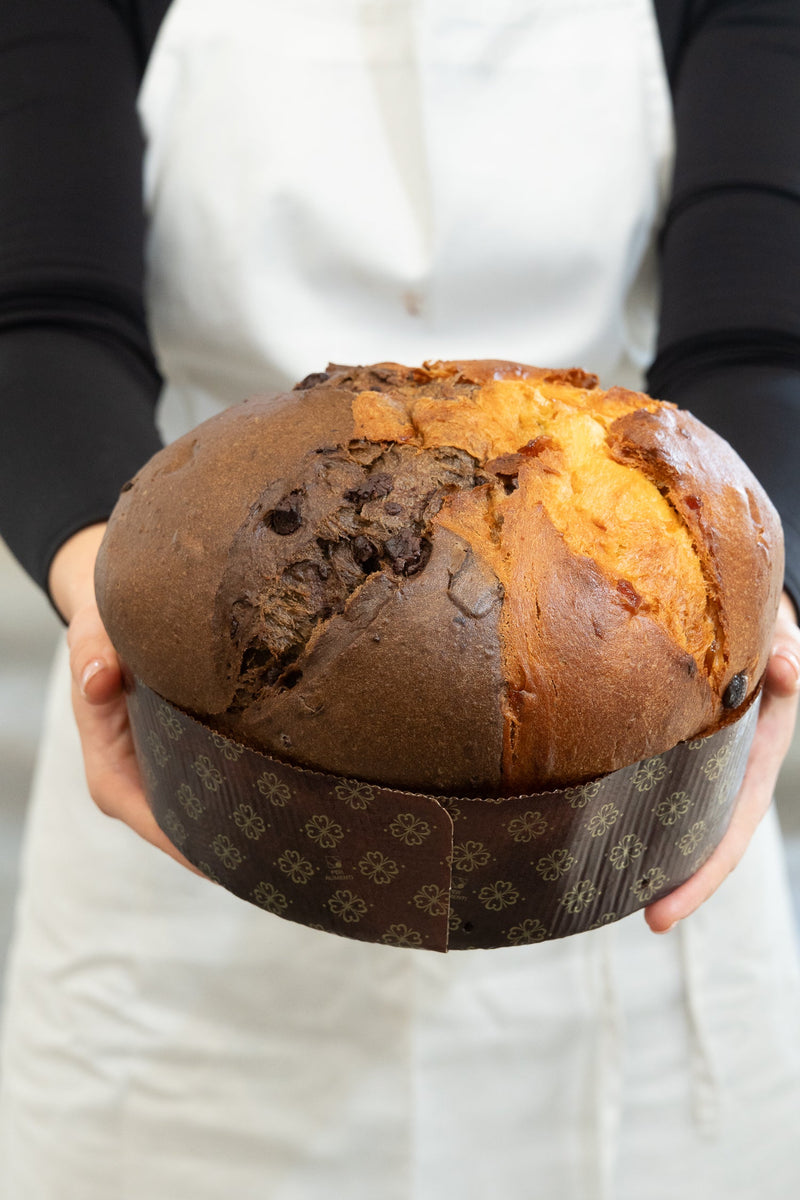
From Arzignano to Guam, in the Mariana Islands, Western Pacific. This is the journey of one of the thousands of Olivieri 1882 panettone cakes that, starting from the former Pellizzari factory—now the nerve center of Venetian pastry-making—reach all corners of the globe. This is no gastronomic fairy tale; it is the result of an entrepreneurial vision that has turned a small shop into a perfectly synchronized artisanal machine, capable of speaking the language of both haute pâtisserie and digital commerce.

A "battering ram" and a vision. Credit goes to Andrea and Nicola Olivieri, the fifth generation of a family active in the pastry business for 140 years, who, thanks to their father's trust, took over the company with full decision-making powers in 2015. The former handles the commercial and marketing side, while the latter is the CEO and head baker. They are just over thirty, but they know that making a good product is not enough for growth. You need a vision: they bet on e-commerce and panettone: "We decided that panettone had to be our battering ram, and we built the structure around it," explains Nicola Olivieri, the online sales strategist. They began by transforming the old Pellizzari industrial warehouse into a venue with a laboratory, now equipped with a cleanroom: a facility with an air environment containing an extremely low level of suspended dust microparticles. They internationalized the brand's language. And they chose to verticalize every skill.
Shipments to 116 countries. E-commerce launched in 2017. "At the beginning, 94% of our revenue was tied to retail; today, 46.5% comes from direct sales. It’s a pioneering choice. In eight years, we have redesigned the site three times; we like working on the details. We invest in logistics, software, storytelling, and customer care," says Andrea Olivieri. "Today we ship to 116 countries, and in 2023 we reached 2 million euros in revenue from e-commerce alone, a 71% increase over the previous year."

Quality remains at the center. In 2016, Olivieri produced 70 panettoni a day. Today it's 2,000. Always with the same philosophy. "The dough is almost the same as it was back then, but the management has been completely rethought: there is an internally designed forming roller, connected ovens that can be controlled remotely, and absolute traceability for every ingredient. Supporting this growth is only possible if it is supported by an organization upstream," adds Nicola, head of production. "We are still a small shop, but we deliver worldwide." The secret is a "standardization toward excellence" that allows Olivieri to be both a shop and a system. Without losing its identity.
The world as a horizon of flavors. From panettone to e-commerce. And vice versa. Because the product remains the same, but the audiences, markets, needs, and the story act as a *fil rouge*. "Until we explained it, in America they would put panettone in the freezer because they see it as a cake, like the others. Some things are not taken for granted," Nicola Olivieri recounts with a smile. Today, the Olivieri 1882 panettone range adapts to the world, which becomes a horizon for tastes developed for specific markets: there is Cupuaçu and Chocolate for Brazil, Black Sesame and Candied Lemon designed for South Korea, and Melomakarono, inspired by the traditional Greek Christmas cookie. And there is no shortage of reinterpretations in the use of the panettone itself, which can become a ham & cheese panettone toast with apple jam and mustard, or the base for french toast. And this is not just adaptation: it is strategic planning.

Science and craftsmanship, a virtuous network. Working around Olivieri 1882 (and other local companies) is the University of Padua, which entered the laboratory through Confartigianato Vicenza to carry out research. Flow studies, air analysis, and then the introduction of the cleanroom. "Today we have all the tools to extend shelf life without losing quality. In 2024, we had only 3 cases of mold out of 180,000 pieces produced," points out Nicola Olivieri. "It was an enriching experience of applied research," explained Professor Stefania Balzan.
And the colomba? It is sold only in Italy. This is not a coincidence, but a clear choice, balancing an artisanal structure with organized thinking. "Abroad, Easter has little weight, and in Italy, the commercial window is too narrow. Producing it makes sense; making it a strategic pillar does not," the two brothers emphasize. Four-day natural leavening, double kneading, four times the egg yolks required by the regulations, artisanal candied fruit. Alongside the classic version, there is also Three Chocolates, Apricot and Salted Caramel, White Chocolate and Berries, Strawberry and Lemon, in addition to the Ginger and Lemon Colomba Egg.

Asia and AI, the new frontiers. Today the focus is on Asia, live sales, and artificial intelligence in processes and customer care. "Among the countries we sell in, Asia is missing: that is where we want to expand. We are also working on live sales, like on TikTok," says Andrea, "and we are studying the integration of artificial intelligence into all business phases." The future is not another website, but a different way of connecting the artisan and the consumer. In the meantime, we have tasted the panettone from the world, and it would be worth giving them a chance in Italy as well, perhaps in limited edition. But the classic one, the progenitor of every product that starts in Arzignano, remains a benchmark. Not because of trends, but because of method.